







Semaglutide vs Tirzepatide: The 2026 Patient Comparison Guide
In recent clinical trials comparing the two leading metabolic medications side by side, patients taking tirzepatide lost an average of 50 pounds, compared to about 33 pounds for those taking semaglutide (Source: SURMOUNT-5 Trial, Wharton et al., NEJM 2025). The clinical landscape has shifted significantly in recent years. In 2026, the question is no longer whether these medications work. The core question is which medication aligns specifically with your biological profile. If you have spent the last few days toggling between pricing pages and forums trying to figure out which path to take, the sheer volume of information can feel overwhelming. You do not have to make this medical decision alone or base it on internet rumors. This comparison guide details the most recent 2026 clinical data, examines side effect realities, and explains how a medical provider helps match the right medication to your unique metabolic needs. Navigating the choice between semaglutide vs tirzepatide requires looking past the brand names to understand the underlying science driving the results.

Key Takeaways
- Patients taking tirzepatide lost an average of 20.2% of their body weight over 72 weeks, compared to 13.7% for those on semaglutide (Source: SURMOUNT-5 Trial, Wharton et al., NEJM 2025).
- Tirzepatide targets two distinct hormonal pathways in the body to accelerate fat loss, while semaglutide targets only one.
- Both medications share similar gastrointestinal side effect profiles, with mild nausea being the most common symptom during initial dose adjustments.
- Many patients successfully switch from semaglutide to tirzepatide to restart their metabolic progress after hitting a sustained weight loss plateau.
- Compounded formulations provide the exact same active pharmaceutical ingredients as brand name medications but require careful sourcing from fully licensed, regulated facilities.
How single and dual agonists work in the body
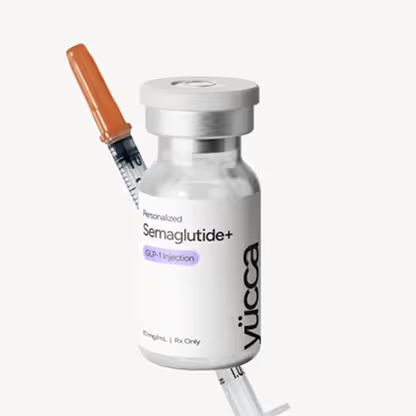
Medications like semaglutide and tirzepatide correct underlying metabolic pathways rather than relying on willpower. Semaglutide is a selective GLP-1 receptor agonist. A GLP-1 receptor agonist is a medication that mimics the natural incretin hormones your gut releases after eating to signal fullness and slow digestion. Incretin hormones are metabolic messengers that tell your pancreas to release insulin and your brain to stop craving food.
Semaglutide binds to these specific receptors to effectively delay gastric emptying. Gastric emptying is the process of food moving from your stomach into your small intestine. This delayed digestion keeps you feeling satisfied for hours after a small meal. If you want to understand more about how GLP-1 agonists work, it helps to look at the secondary medication options available today.
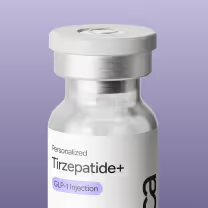
Tirzepatide is a dual targeted receptor agonist. A dual targeted receptor agonist is a medication that simultaneously binds to two different hormonal pathways to amplify metabolic regulation. It targets both GLP-1 and GIP, or glucose-dependent insulinotropic polypeptide, is a secondary hormone that further suppresses appetite and improves how your body processes fats and sugars.
Think of these medications as fixing a broken thermostat. Trying to force your body to lose weight when your metabolic hormones are out of balance is like trying to heat a house with the windows open. You burn a massive amount of energy, but the thermostat remains fundamentally broken. Semaglutide fixes the thermostat by turning down the hunger dial and slowing your digestion. Tirzepatide fixes the thermostat and closes the windows at the same time. Because it acts on two distinct pathways, many patients experience stronger appetite control. This combined effect accounts for the greater absolute weight loss seen in recent clinical trials.
Semaglutide vs Tirzepatide: Comparison Table
MechanismAvg Weight Loss %Dosage FrequencyHormones TargetedSingle agonist13.7% to 14.9%Weekly injectionGLP-1Dual agonist20.2% to 20.9%Weekly injectionGLP-1 and GIP
What 2026 clinical data reveals about efficacy and weight loss averages
The most comprehensive data comparing these two medications comes from direct, head to head clinical trials. Patients lost an average of 20.2% of their body weight on tirzepatide versus 13.7% on semaglutide after 72 weeks (Source: SURMOUNT-5 Trial, Wharton et al., NEJM 2025). Specifically, individuals lost 22.8 kilograms on tirzepatide compared to 15.0 kilograms on semaglutide (Source: SURMOUNT-5 Trial, Wharton et al., NEJM 2025).
That specific data matters. It demonstrates a clear statistical difference in absolute mass reduction. Patients on tirzepatide also reduced their waist circumference by an average of 18.4 centimeters, compared to 13.0 centimeters on semaglutide (Source: SURMOUNT-5 Trial, Wharton et al., NEJM 2025). Nearly 50% of patients taking tirzepatide lost at least 20% of their total body weight, compared to 27.3% of those taking semaglutide (Source: SURMOUNT-5 Trial, Wharton et al., NEJM 2025).
This efficacy translates consistently beyond sterile lab environments. In real-world U.S. clinical practice, tirzepatide yielded a greater six month mean percentage weight reduction of 11.15% compared to 8.83% for semaglutide (Source: Truveta Research Team, Journal of Endocrinological Investigation 2026). This validates that the clinical trial outcomes mirror what actually happens in everyday patient populations.
Why tirzepatide causes more weight loss than semaglutide comes down to its dual action mechanism. Tirzepatide targets both GLP-1 and GIP metabolic receptors. While semaglutide relies solely on the GLP-1 pathway to regulate appetite and slow digestion, the addition of the GIP receptor in tirzepatide synergistically enhances energy expenditure. This combined approach improves lipid metabolism and provides a stronger suppression of food noise, leading to higher overall weight reduction.
Food noise is the constant, intrusive loop of thoughts about eating and planning your next meal. Quieting this psychological burden is often the most profound relief patients experience during early treatment.
Safety profiles remain remarkably similar across both treatments. Gastrointestinal side effects were the most common reason for stopping the medication entirely. These symptoms occurred in 2.7% of tirzepatide users and 5.6% of semaglutide users during a head to head trial (Source: SURMOUNT-5 Trial, Wharton et al., NEJM 2025). Nausea affects roughly 25% of tirzepatide users and 20% of semaglutide users (Source: SURMOUNT-1 Investigators, Jastreboff et al., NEJM 2022). Most of these symptoms present during the initial dose titration phase. The dose titration phase is the period of gradually increasing your medication amount over several months to let your body adjust safely.
When to switch medications to break a weight loss plateau
Experiencing a stall in weight loss after several months of steady progress is a normal physiological response. Hitting a plateau on semaglutide does not mean your body is broken. It simply means your system has adapted to the current level of metabolic support. When this happens, patients often wonder if they need to double down on restrictive diets or excessive exercise.
Instead, introducing a secondary mechanism through tirzepatide can often restart metabolic progress. Many patients safely switch to tirzepatide after reaching a maintenance plateau on semaglutide. A maintenance plateau is a period of four or more weeks where your body weight remains entirely unchanged despite consistent medication use. Because tirzepatide activates the additional GIP hormonal pathway, it can act as a new biological key to unlock stalled metabolic functions.
The process of cross-titration requires professional medical guidance. Cross-titration is the medical process of safely decreasing one medication while simultaneously introducing a new one to prevent harsh side effects. A Yücca medical provider will determine the appropriate schedule to ensure a safe and effective transition. You do not necessarily have to drop back to the lowest starting dose and lose months of progress. Your provider calculates an equivalent starting point based on your current semaglutide tolerance.
Transitioning between medications is also a natural moment when patients evaluate the cost of compounded semaglutide vs tirzepatide options. Both compounded formulations provide a more accessible pathway than brand name medications, which frequently exceed $1,300 per month out of pocket. Reviewing semaglutide and tirzepatide options can clarify the financial aspect of this transition. Compounded semaglutide and compounded tirzepatide contain the exact same active pharmaceutical ingredients as their respective brand names.
Yücca strictly utilizes state licensed compounding pharmacies to ensure absolute safety and sterility. A state licensed compounding pharmacy is a highly regulated facility that creates customized medications from pure pharmaceutical ingredients to meet specific patient needs. The FDA recently issued warnings regarding unverified compounding facilities that dispense unauthorized salt formulations of these drugs (Source: FDA Press Announcements, 2026). Securing your medication through a verified provider is absolutely critical for your health.
Managing daily side effects and unexpected fatigue
The fear of severe gastrointestinal side effects often causes unnecessary anxiety for patients considering these medications. Many people read horror stories about extreme nausea or fatigue online and hesitate to begin treatment.
Both medications share similar gastrointestinal side effect profiles, including nausea, bloating, and constipation. However, 2026 clinical reviews suggest that despite its higher potency, tirzepatide may offer slightly better tolerability for some users. This improved tolerability is largely due to the GIP component’s ability to balance metabolic signals more effectively than GLP-1 alone. Understanding these common side effects helps patients prepare for the first few weeks of treatment.
Fatigue is another common symptom that patients frequently discuss in community forums. Profound fatigue that makes exercise and daily functioning difficult can occur with either medication. This lethargy is usually temporary. It stems directly from the body adjusting to functioning on significantly fewer calories while simultaneously managing entirely new hormonal signals.
Some patients also report experiencing sulfur burps during the first few weeks of dose escalation. Sulfur burps are specialized gastrointestinal belches that smell like rotten eggs, caused by food fermenting in the stomach due to delayed digestion. Eating smaller, more frequent meals and avoiding highly processed or greasy foods can dramatically reduce this symptom.
Muscle preservation is another vital consideration during the treatment process. Rapid weight loss can sometimes result in the loss of lean muscle mass along with fat. Patients must prioritize adequate protein intake and actively incorporate resistance training. Protecting your lean muscle ensures that your metabolism remains robust even as your overall body mass decreases.
How female biology and hormones respond to treatment
Biological differences play a significant role in how metabolic medications perform. The SURMOUNT-5 trial demonstrated that female participants tend to see slightly more pronounced weight loss benefits than male participants. On tirzepatide, female participants lost an average of 23.8% of their body weight, compared to 17.8% for male participants (Source: SURMOUNT-5 Trial Sub-analysis, 2025). On semaglutide, female participants lost 18.0%, compared to 11.0% for male participants (Source: SURMOUNT-5 Trial Sub-analysis, 2025).
These outcomes are particularly relevant for patients managing polycystic ovary syndrome. Polycystic ovary syndrome, commonly known as PCOS, is a hormonal disorder causing enlarged ovaries with small cysts, often linked to severe insulin resistance. Insulin resistance is a condition where your cells stop responding to insulin, forcing your pancreas to produce more of it and leading to increased fat storage.
While neither medication is officially FDA approved specifically for PCOS, the insulin sensitizing effects offer substantial clinical benefits. These medications help manage stubborn weight retention and irregular cycles by addressing the root cause of the metabolic dysfunction.
There are critical safety considerations regarding oral contraceptives. Tirzepatide delays gastric emptying to a degree that can temporarily reduce the efficacy of oral birth control pills. Patients must use a backup barrier method, such as condoms, for four weeks after starting the medication. You must also use a backup method for four weeks after every dose escalation.
This rule matters significantly because sudden weight loss can unexpectedly boost fertility. Patients with anovulatory cycles often find their fertility returning rapidly as their metabolism stabilizes. Anovulatory cycles are menstrual cycles where the ovaries fail to release an egg, a common symptom of severe metabolic imbalance.
Both medications must be entirely discontinued at least two months before attempting to conceive. This waiting period allows the long acting compounds to clear completely from your system, ensuring optimal safety for early fetal development.
Technical CMS directive for the publishing team: Ensure the CMS is configured to output strict JSON-LD FAQPage schema for this section, alongside a standard BreadcrumbList schema mapping back to the main /resources directory, to maximize structured data presentation in search results without hitting dynamic page constraints.
Frequently Asked Questions
Which is more effective for weight loss: semaglutide or tirzepatide?
Clinical data in 2026 shows that tirzepatide generally leads to higher weight loss, with patients averaging a 20.9% reduction in body weight over 72 weeks compared to approximately 14.9% for semaglutide. This is attributed to tirzepatide’s dual-action mechanism, which targets both GLP-1 and GIP metabolic receptors.
What is the main difference between semaglutide and tirzepatide?
The primary difference lies in their hormonal targets. Semaglutide is a single-hormone agonist that mimics GLP-1 to regulate appetite. Tirzepatide is a dual-hormone agonist, mimicking both GLP-1 and GIP. This "twincretin" approach often results in more significant metabolic improvements and faster satiety for many patients.
Are the side effects worse for tirzepatide or semaglutide?
Both medications share similar gastrointestinal side effects, including nausea, bloating, and constipation. However, 2026 clinical reviews suggest that despite its higher potency, tirzepatide may offer slightly better tolerability for some users due to the GIP component’s ability to balance metabolic signals more effectively than GLP-1 alone.
Can I switch from semaglutide to tirzepatide if I plateau?
Yes, many patients switch to tirzepatide after reaching a weight loss plateau on semaglutide. Because tirzepatide activates an additional hormonal pathway (GIP), it can often restart metabolic progress. A Yücca medical provider will determine the appropriate cross-titration schedule to ensure a safe and effective transition.
Is compounded semaglutide as effective as brand-name Wegovy?
Compounded semaglutide contains the same active pharmaceutical ingredient as brand-name versions and is prescribed to achieve similar weight loss outcomes. At Yücca, we use state-licensed compounding pharmacies to ensure high-quality, sterile preparations that meet rigorous safety standards, providing an accessible alternative to name-brand medications.
How long does it take to see results on tirzepatide vs semaglutide?
Tirzepatide users often report seeing shifts in body composition by week 12 due to its dual-agonist potency. Semaglutide typically follows a more gradual trajectory, with steady results appearing as the dosage is titrated up over 16 to 20 weeks. Individual results vary based on starting BMI and metabolism.
If you are wondering whether this could be part of your health journey, you do not have to figure out your biological puzzle on your own. Talk with a licensed Yücca provider about your health history and current symptoms to find the starting point that makes the most sense for your body. You can complete a brief health assessment at tryyucca.com and hear back from a real clinician with a personalized treatment recommendation.
References

Aaron Lee is the co-founder and CEO of Yucca Health, with over a decade of experience spanning clinical operations, growth marketing, and healthcare strategy. His writing draws on 15+ years in the industry to explore health, technology, and the systems worth fixing — making complex topics clear and actionable.
Read Full Bio