

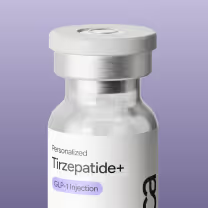
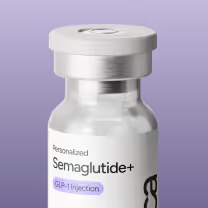


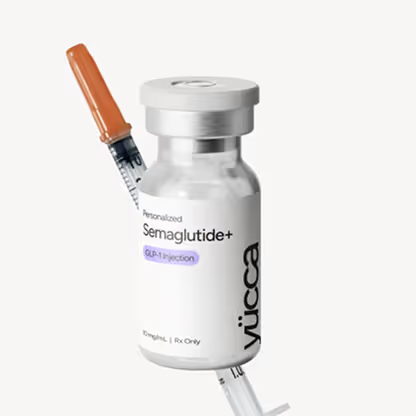



In the latest head-to-head clinical trials, patients taking a 15 mg dose of tirzepatide lost an average of 20.2 percent of their body weight, compared to 13.7 percent for those on a 2.4 mg dose of semaglutide (Source: SURMOUNT-5, 2024). You might see people online losing weight instantly, but your body requires time to adjust to these powerful treatments. When you compare semaglutide vs tirzepatide weight loss results 2026 data, the timeline for success becomes much clearer. Weight management is a complex biological process that relies on steady hormonal adjustments rather than a simple willpower contest.
We are looking at the newest clinical updates to show you what a realistic roadmap actually looks like. By understanding the science behind non-surgical weight loss 2026 options, you can set accurate expectations for your own metabolic health journey.

Key Takeaways
- Tirzepatide users lost an average of 20.2 percent of their total body weight over 72 weeks in direct head-to-head trials against semaglutide.
- Semaglutide users achieved a highly durable average weight loss of 13.7 percent in the same 72-week comparative study.
- The first four to eight weeks of your treatment serve as a loading phase to prime your body, with significant fat burning accelerating after month three.
- Combining these medications with proper protein intake and hormone support helps preserve lean muscle mass and increases overall metabolic efficiency.
- High-dose clinical data and targeted hormone therapies are changing how providers prescribe these treatments in 2026.
Understanding the hormone signals of single versus dual agonists
Comparing the biological mechanisms of these treatments requires looking at how they interact with your natural biology. Semaglutide is a selective GLP-1 receptor agonist, a medication that mimics a natural gut hormone to signal fullness to the brain and slow digestion. It effectively acts as a volume dial for your physical hunger. When you eat a meal, this medication helps keep the food in your stomach for a longer duration. This process targets the specific satiety centers in your brain to significantly reduce your daily calorie intake without causing a feeling of starvation or deprivation.
Tirzepatide takes a slightly different biological approach. It acts as a dual agonist, a medication that targets two separate hormone receptors to maximize metabolic efficiency. Alongside the standard GLP-1 pathway, it also mimics GIP, a digestive hormone that helps your body process sugar and fat to boost overall metabolic function.
This difference is central to the dual-agonist vs single-agonist conversation among medical professionals.
Think of semaglutide as a single dial that turns down your appetite. Tirzepatide offers two distinct dials. One turns down your appetite, while the second acts as a metabolic booster for your internal engine. By activating both pathways simultaneously, tirzepatide often provides a much more robust signal to the body to release stored fat.
Both of these medications fall under the broader category of incretin mimetics, a class of drugs that imitate natural metabolic hormones to regulate appetite and blood sugar. They also both strongly influence gastric emptying, the speed at which food leaves your stomach and enters your small intestine.
When evaluating GIP vs GLP-1 weight loss mechanisms, the addition of the GIP receptor is what researchers believe gives tirzepatide a clinical edge. This dual action can make the medication more effective for patients who struggle with severe metabolic resistance. Understanding why is tirzepatide more effective than semaglutide comes down to this compounded hormonal signaling. It creates the mental space needed to build better habits by quieting the constant background thoughts about food.
Average clinical weight loss outcomes in 2026
The medical community gained vital clarity this year regarding clinical expectations for these specific active ingredients. The SURMOUNT-5 trial provided the first direct comparison between the two leading molecules. In this extensive study, 751 adults with obesity were evaluated meticulously over a year and a half. The tirzepatide 15mg weight loss results 72 weeks data showed an average body weight reduction of 20.2 percent (Source: SURMOUNT-5, 2024).
In the exact same trial, patients on standard semaglutide experienced different, yet highly effective, outcomes. The average weight loss on semaglutide reached 13.7 percent over the identical 72-week period.
That specific distinction matters because most patients do not know to ask about the difference in these clinical percentages.
Other foundational medical studies support these numbers. The STEP 1 trial evaluated 1,961 adults without diabetes over 68 weeks. It found that a 2.4 mg dose of semaglutide resulted in a mean weight loss of 14.9 percent (Source: STEP 1, 2021). Furthermore, semaglutide results after 1 year remain highly durable for most patients. The subsequent STEP 5 trial confirmed this long-term durability, showing a 15.2 percent body weight reduction sustained through 104 weeks (Source: STEP 5, 2022).
The SURMOUNT-1 trial offered even more insight into the GIP and GLP-1 combination. It evaluated 2,539 adults over 72 weeks. Patients in this study utilizing the maximum dose achieved a remarkable mean weight loss of 20.9 percent, which equated to roughly 48 pounds for the average participant (Source: SURMOUNT-1, 2022).
Comparison of semaglutide and tirzepatide weight loss percentages
There is also a well-documented phenomenon known as the super-responder effect. In the recent SURMOUNT-5 trial, 31.6 percent of tirzepatide patients achieved a weight loss of 25 percent or more of their total body mass. New data released early in 2026 regarding high-dose Wegovy and emerging oral peptides continues to show that pushing past the standard therapeutic threshold yields even greater fat reduction for these super-responders.
Cost and access often dictate which treatment path a patient ultimately chooses. Brand-name GLP-1s command premium prices, frequently exceeding $1,300 per month out of pocket. This financial reality drives many patients toward compounded options through comprehensive telehealth programs. Compounded peptide safety relies on strictly regulated pharmacy facilities that utilize high-quality active ingredients. Yücca providers prescribe these compounded medications based on careful evaluation of individual patient needs, making sustainable, long-term treatment far more accessible.
Navigating your 12-month weight loss timeline
Patience is a necessary clinical tool when starting any metabolic treatment program. If you are wondering how much weight can you lose on semaglutide in 6 months, the answer depends entirely on your specific biology and strict adherence to the required escalation protocol.
The first four to eight weeks of your GLP-1 titration schedule act exclusively as a loading phase.
This initial period is designed to prime your body and build medication tolerance, not to maximize fat burning. Many patients experience anxiety during this first month if the scale does not move immediately. This slow start is actually a built-in safety feature designed to minimize gastrointestinal side effects like nausea and fatigue.
Your realistic monthly weight loss on tirzepatide or semaglutide shifts dramatically once you enter the therapeutic window. This window typically opens around week 12 of your treatment. At this vital stage, your body has adjusted to the medication, and the dosage is high enough to significantly impact your metabolic function. For a comprehensive look at the tirzepatide weight loss timeline, you can expect minor body composition changes in month one, steady scale drops beginning in month three, and peak momentum occurring between months six and nine.
You will inevitably encounter weight loss plateaus on GLP-1s during your medical journey.
The most common stall occurs around week 36. This plateau is a normal biological response as your body actively adjusts to its new physical size and altered metabolic rate. Research highlights that while the most rapid dropping occurs in the first 36 weeks, continuing the treatment prevents weight regain and allows the body to stabilize (Source: SURMOUNT-4, 2024).
Understanding your unique semaglutide weight loss milestones helps you stay the course when progress feels slow. Clinical data shows that patients reach an average weight loss of 10.6 percent by week 20 of their protocol (Source: STEP 4, 2021). If you experience a prolonged stall beyond this point, you might consider switching from semaglutide to tirzepatide for weight loss. This specific transition requires a structured dose-conversion protocol guided by a qualified medical provider. You can review a detailed breakdown of the required titration schedule to see exactly how these medication transitions are managed safely.
How hormones and life stages impact your metabolic results
Biological nuances play a massive role in how your body responds to metabolic treatments. Factors like age, severe insulin resistance, and fluctuating sex hormones dictate both the speed and the overall quality of your physical progress.
Declining hormone levels during menopause can make fat reduction significantly more difficult for many patients.
Recent clinical data highlights a powerful synergy between incretin mimetics and targeted hormone replacement therapies. Postmenopausal adults using tirzepatide alongside menopausal hormone therapy experienced 35 percent more weight loss than those not utilizing additional hormone support (Source: Mayo Clinic, 2026). This proves that treating the whole endocrine system yields superior clinical outcomes compared to isolated weight management.
Patients dealing with severe insulin resistance, such as those diagnosed with polycystic ovary syndrome, face entirely unique hurdles. The dual action of tirzepatide is often highly effective in these specific medical scenarios. The added GIP component helps overcome the stubborn metabolic resistance that standard single-agonist treatments sometimes fail to breach.
Preserving lean mass is another critical consideration for any adult undergoing a rapid weight reduction protocol. Losing weight too quickly without adequate daily protein intake can lead to muscle wasting. This negatively impacts your resting metabolic rate and compromises your physical strength. High-quality clinical data confirms that up to 70 percent of the weight lost on these medications is fat mass, provided the patient maintains proper nutrition and engages in resistance training (Source: Cell Reports Medicine, 2026).
You must actively protect your lean tissue to avoid looking gaunt or feeling physically weak. Setting accurate expected weight loss results involves prioritizing body composition over a simple scale number. Many patients optimize their final outcomes when their primary GLP-1 medication is paired with muscle recovery treatments like Sermorelin. This comprehensive approach ensures you are losing stubborn fat while keeping your baseline metabolic engine running strong.
Frequently Asked Questions
What is the average weight loss on tirzepatide vs semaglutide?
Clinical data updated in 2026 shows that patients on the highest dose of tirzepatide (15 mg) lose an average of 20.9% to 22.5% of body weight over 72 weeks. In comparison, patients on standard semaglutide (2.4 mg) lose approximately 14.9% to 15.3% of their total body weight.
How much weight can I lose on semaglutide in the first 3 months?
Most patients lose between 5% and 10% of their starting weight during the first 12 weeks of semaglutide treatment. However, the first month often involves lower "loading doses" to minimize side effects, meaning significant fat loss typically accelerates after the third dose titration around week 12.
When do you start losing weight on GLP-1 medications?
While appetite suppression often begins within days of the first injection, measurable weight loss usually appears between weeks 3 and 4. Significant, steady progress is typically documented after the first 8 to 12 weeks as the patient reaches a therapeutic dose and the body’s metabolism adjusts.
Can I switch from semaglutide to tirzepatide if I hit a plateau?
Yes, patients can switch medications under medical supervision if weight loss stalls. Because tirzepatide targets two hormones (GIP and GLP-1) while semaglutide targets only one, many patients find that switching helps overcome plateaus. A specific dose-conversion protocol is required to ensure a safe and effective transition.
Is 20% weight loss realistic on tirzepatide?
For many patients, 20% weight loss is a clinically supported benchmark over a 72-week period. Reaching this goal depends on reaching the maximum 15 mg dose, consistent adherence to the weekly injection schedule, and pairing the medication with a high-protein diet and resistance training to preserve lean muscle mass.
Why am I not losing weight on semaglutide yet?
If you are in the first 4 to 8 weeks, you are likely on a low titration dose intended to build tolerance. Weight loss often remains modest until you reach "therapeutic" levels (1.7 mg or 2.4 mg). Factors like insulin resistance, protein intake, and sleep quality also influence early results.
Achieving a healthier body composition requires understanding your unique biology and choosing a treatment path backed by robust clinical data. If you are wondering whether this approach could be part of your journey, a licensed Yücca provider can walk you through whether it fits your long-term health goals. You can complete a short health assessment at quiz.tryyucca.com and hear back from a real clinician to explore your personalized metabolic baseline safely and effectively.
References

Aaron Lee is the co-founder and CEO of Yucca Health, with over a decade of experience spanning clinical operations, growth marketing, and healthcare strategy. His writing draws on 15+ years in the industry to explore health, technology, and the systems worth fixing — making complex topics clear and actionable.
Read Full Bio